Here there be dragons What happens when you let a physicist teach biology? Science, that’s what! Well, not at first. I still have my science teaching notes (in the form of overheads) from 25 years ago and at the time, I taught the biology unit of grade 10 science in a very traditional way. Fast forward 22 years and I found myself teaching grade 10 science again, now with a very different perspective on learning. As part of my redesign of our school’s grade 10 science course, I needed to build a biology unit from scratch. I have absolutely no university training in anything remotely biological, so I felt ready to give it a go! For me it was terra incognita, unknown country. As my guide, all I had were the learning principles I chose for the grade 10 course: questioning and scientific observation. When I described to my colleagues what I was doing, they thought it crazy. But fools rush in…
Putting away the axe I have been grinding an axe about biology education ever since I changed the way I taught physics, roughly 20 years ago. My impression of biology learning was that of information washing over students who desperately try to stay on top of the rising tide of terms and diagrams. It appeared to me like a lot of cognitively disconnected, unmotivated learning. Looking back on my old overheads, this is exactly how I taught it for many years, and it was hard to see what the alternative might be. An important step for me in the design process of the new biology unit was understanding why this old-fashioned approach was, in its way, successful. After all, people have become doctors and medical researchers. What can we learn from this?
Simplicity versus complexity Physics, as it appears at the high school level, is a science of simplicity. Remember that joke about spherical cows? We represent complex systems as simple point particles and appeal to very powerful, abstract principles to explain and predict. Importantly, the number of such principles is small: force, energy, and momentum. The population of the young physicist’s cognitive universe is very small. Indeed, much of our physics teaching is helping students with the many subtelties of using this small but powerful set of principles. The biological world, as it appears at the high school level, is fundamentally different. It is a strange, complex world whose inhabitants have unfamiliar names and functions. Its microcosm and macrocosm are rich with diversity and splendour. Here is a 3D video simulation of just one part of this world. So much strange stuff!
What is going on in this video? It is hard to answer this question without invoking many strange and puzzling words. This complexity must be tamed and has been so in the past by studying, classifying, and naming the many things of the biological world. I felt something was wrong with this emphasis, and with my grinding wheel and axe from physics education research, I had much unhelpful advice for my biology teaching colleagues. It took me a long while to appreciate how important memorization is to the study of biology. I had to sheathe the axe and approach the challenge on its own terms. In this article, I share what I feel is a successful solution to this challenge, so let’s begin with the most important observation in all of biology, according to this physicist.
A world in a drop of water: Lessons 1 & 2 What do you think we will see when we look at a drop of water under a microscope? Most students really don’t know what they will see and suggest all sorts of interesting things. What do we do in science when we don’t know? When I say this in class, my students have been trained to exclaim the answer out loud: we do experiments! I think this is one of the most important observation experiments in all of biology: a drop of pond water under a microscope. Here is what I saw:
Students should not leave high school without seeing this! By the way, I have kept pond water “alive” for many months, so it’s a year-round observation. I hope you noticed in the second video that students are using their phones for good and not evil – for science! This has been a game changer and is something I highly, highly recommend: purchasing 10 smartphone mounts for classroom microscopes. I tested three different mounts and the Celestron DX was the best for durability and ease of use. Our parent’s council fundraised money for this and it was worth every cent. In groups of four, students make this observation and they freak out when they first see something move! The best part is that this experience is shared: with the phones they can easily discuss what they see and help each other use the microscope. As we go through these lessons, feel free to follow along with the worksheets for the students.
The big questions of biology Imagine what it would have been like to have been the first person to put a drop of pond water under a microscope, not knowing what to expect. It must have been an amazing experience for the pioneers of microscopy: Antonie van Leeuwenhoek and Robert Hooke (yes, the physicist!). But this is what our students experience! They will feel that thrill of discovery as long as you don’t spoil it for them. The bonus of observations like this is that students spontaneously start asking the big questions of biology: Is this alive? How can we tell? How do we decide? What are the characteristics of living things?
Designing a science unit In a previous article, Designing a Unit in Science: A Three-Year Journey, I shared in outrageous detail the thinking process I used to develop our grade 10 chemistry unit. I encourage you to visit (or revisit) that article! Here is a quick summary of this process with the biology unit in mind.
Examine the curriculum. We need to cover cell division, cell types, tissue types, and organ systems in plants and animals. Wow, isn’t this basically all of biology? Potentially, this is an awful lot of disconnected knowledge!
Think like a scientist. Microscope observations opened up a new world of biological exploration. What questions did people have the first time they made these observations? What did the first anatomists think? What did they wonder?
Create the scientific narrative. The unit will answer the question, how do things (complex organisms) grow? Examine single celled organisms (pond water) and then complex organisms (onions, humans). Develop a model of nucleus division (mitosis) and then the cell cycle. A simple model cannot explain complexity: the cell cycle must introduce change. Follow the change through embryonic development: from a single cell, to a lump of differentiated cells, to a complex organism with specialized tissues and organs. Explore organ function and human health through the lens of cellular respiration and the cell cycle.
Focus on what is important. Key concepts: the relationship between form and function, cellular respiration and its resources, and cell differentiation leading to complexity (cell types, tissue types, organ, and organ systems).
Authentic skills and meaningful tasks. Make lots of microscope observations, examine actual histology tissue samples, create case studies of medical examination and diagnosing.
Learning is about connections. Keep revisiting the key concepts as our knowledge develops. Apply new knowledge to understand the next level of form and function, and ultimately the dysfunction and symptoms of medical conditions.
Relevance is everything. For students who do not take grade 11 biology, this is their last formal learning about human biology, which is humbling to realize. Aside from Dr. Google and ChatGPT, this is the knowledge they will have when dealing with medical professionals in their own lives - a sobering thought!!
(Microsoft Copilot. (2026). AIgenerated image.)
The challenge of biology learning Now I will indulge in some axe-grinding against our hallowed curriculum documents, which reinforce the discouraging features of traditional biology learning: a wealth of disconnected information to memorize and little scientific rationale to make sense of it.
The overall expectations in the curriculum document are very broad and wide ranging, with no hint of a narrative thread that inquiry could follow. What inquiry attempts to do, when it is done well, is to create a scientific story that answers a meaningful question. It takes time to generate such questions, and more time to explore the possible answers that become the story. A curriculum document such as this short-circuits the inquiry process — the circuit’s energy quickly turns to the heat of memorizing of answers. This curriculum is not designed for inquiry, despite its occasional use of the word.
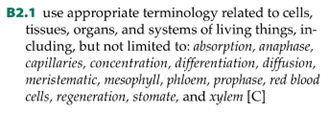
The specific expectation B2.1 illustrates this fault: the terms are scattershot, a word salad that suggest a breadth of content that cannot be covered in a cohesive, meaningful way. A glance at an approved grade 10 science textbook reveals the logical results of this “guidance” — lots of information and little connection to larger questions or deeper biological concepts.
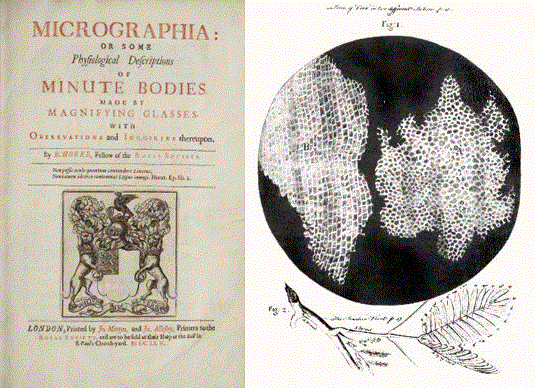
The history of inquiry The history of science is fascinating and can be pedagogically helpful when we explore the scientific spirit of earlier times. What did earlier people think about life and how living things work? They had all sorts of crazy ideas about the function of different organs, the four humors, and human reproduction. How do we get more life? One idea was spontaneous generation — that living matter arises naturally from nonliving matter, as maggots just “appear” from rotting meat. All of these missteps, challenges, and dead ends seemed reasonable at the time, and had to be explored before they could be carefully refuted by experiments. All this is valuable educationally because our students need to confront evidence and go through a similar process of discounting “wrong” theories as they construct a correct and reliable understanding. One such set of evidence comes from Robert Hooke’s Micrographia. Using his improved microscope, he saw within the bark of a cork tree small units that he decided to call “cells”. We find similar evidence using onion skin.
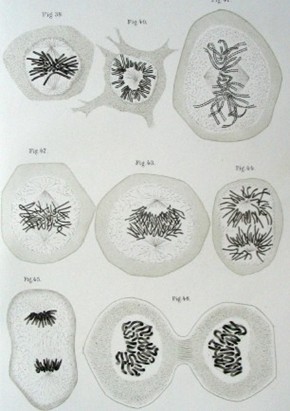
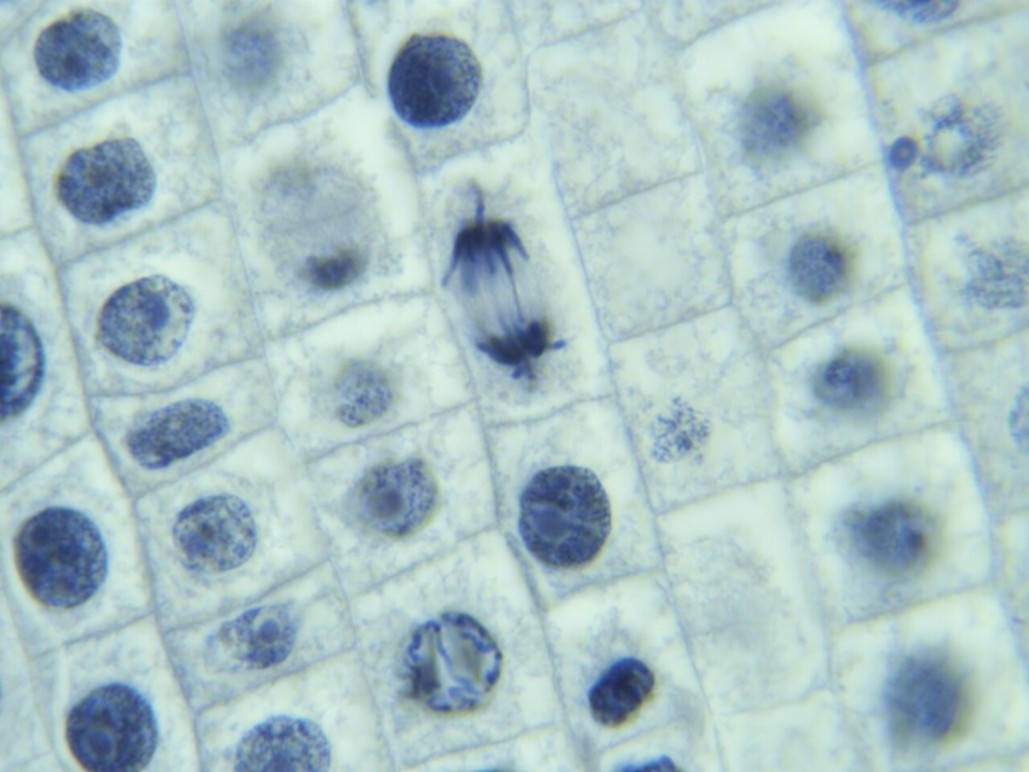
Walter Flemming explored the process of cell division and noticed that the colourful parts, the “chromo”somes, moved and split — a process he called mitosis. We explore this using prepared microscope slides of onion root tips.
An acquaintance with the history of science provides suggestions for the learning experiences, evidence, and scientific framework of our student’s inquiry process. This doesn’t need to be presented as a chronology or as a historical reenactment; we just need students to engage with scientifically important evidence, and the past provides great examples of this.
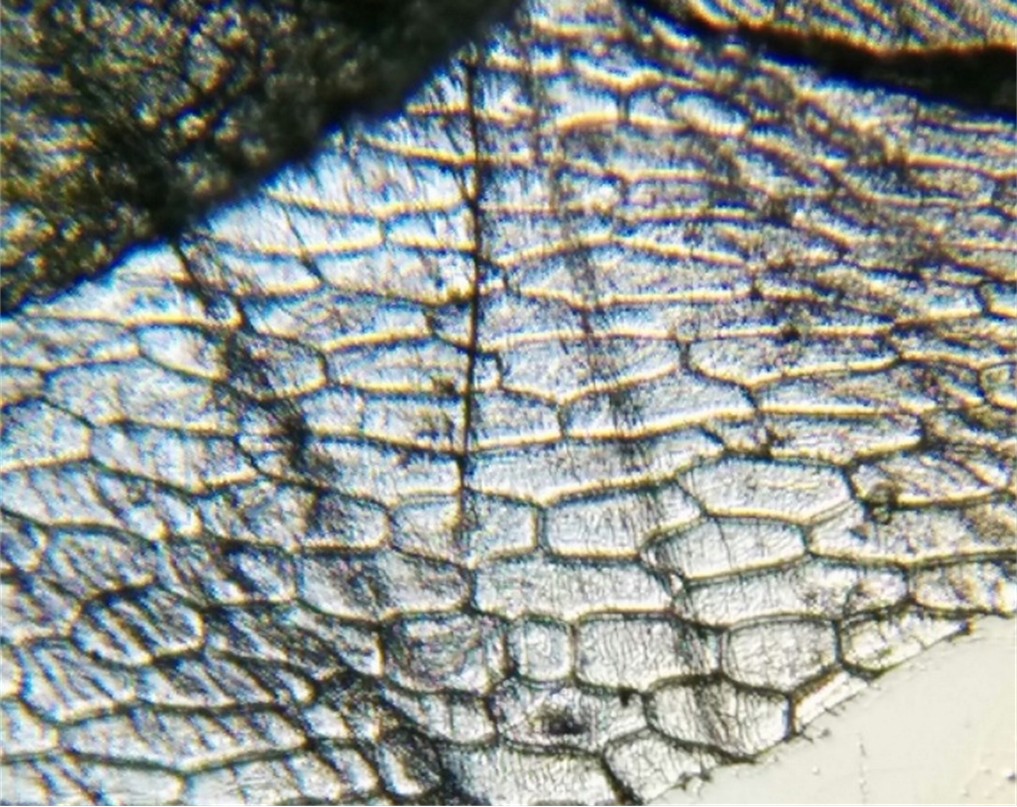
How do things grow? Lesson 3 The driving question for this biology unit is just this: how do things grow? Imagine we could look at the insides of a young organism and a fully grown organism, like an onion. How would the insides look different? I ask students this question and they come up with lots of ideas, all of which boil down to: (1) the size of its cells change or (2) the number of its cells change. These ideas become two plausible explanations, two hypotheses that we need to test. These might not match any historical hypotheses, but this is not a problem! The hypotheses provide a scientific lens through which we examine evidence from key historical observations, helping to make it meaningful for students. We began by looking at single-celled organisms in pond water. Now we follow Hooke and examine a large, grown organism — an onion and its skin. Examine this photograph I took and think about the two hypotheses:
Biology is complex and real samples are challenging to interpret. What does this tell us about our two hypotheses? Are there many cells or just one cell? Are there differences in size? Big differences? Hmm… we see lots of cells with different sizes. Neither hypothesis is completely ruled out, but it is definitely not one big cell. But let’s wonder: why don’t we find large single-celled organisms? (Even more interesting: why aren’t there two-celled organisms? We find single-celled organisms and organisms with many, many cells, but no two-celled ones. There must be a very powerful evolutionary advantage for both one or many but not two cells.)
Exploring the size hypothesis: Lesson 4 So why aren’t we one big cell? Wouldn’t that be much simpler?
(Microsoft Copilot. (2026). AIgenerated image.)
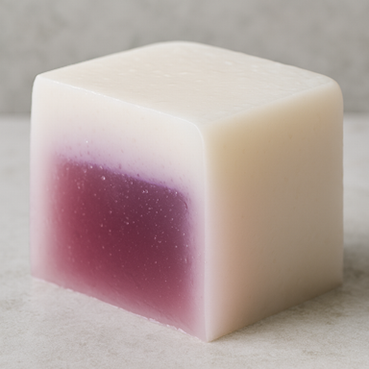
Well, there are many problems with being a large single-celled organism, but we will focus on the one whose resolution foreshadows a defining principle of biology. Our inquiry process now leads us to test the limits of singe cell growth. A vital process that powers cells and cell growth is cellular respiration: glucose + oxygen → carbon dioxide + water. We experiment using agar blocks made with sodium hydroxide and phenolphthalein indicator. In the experiment, we soak the blocks in vinegar. The diffusion of vinegar into the block changes the indicator colour, which models the diffusion of oxygen into a cell.
(Microsoft Copilot. (2026). AIgenerated image.)
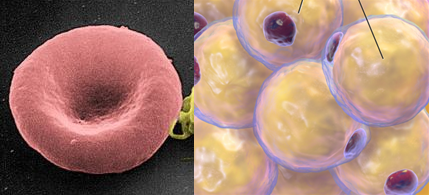
The veteran teacher might have realized by this point that we are performing many of the classic classroom biology experiments. What is largely new here is the inquiry or scientific lens we bring to each exploration: students know why we are doing the experiment, and each experiment adds a piece to our understanding of a larger question. Our work is always purposeful from the student perspective. Also different is the design of this experiment. We test two distinct characteristics, surface area and volume, to see how their changes affect the proportion of the cell that receives oxygen. Our agar blocks are cubes or flat rectangular prisms that has a similar volume to one of the cubes. This is setting the foundation for a critical idea in biology: the connection between form and function. Examine the shape of these cells:
Cells that need to quickly diffuse lots of oxygen in and out are flat, like the red blood cell above. But the spherical fat cell is very quiescent and stores resources for long periods. We are asking and answering meaningful scientific questions. We make lots of connections to core biological ideas, helping the learning make sense and stick in their brains.
The number hypotheses: Lessons 5 & 6 So we have evidence constraining the size of cells, and we have seen how complex organisms are composed of many cells. There is one more piece of evidence we should find to support the number hypothesis — the smoking gun, if you will. What might that be? We want catch cells in the act… in flagrante delicto… in the process of cell division! We will stake out an onion:
In what part of the onion are we likely to catch the cells dividing? The easiest part is the root tip. We use prepared slides for this observation and then move on to an amazing website for high-resolution tissue samples: HistologyGuide.org. What do we notice? Many cells that look “normal” and a small number that look “different”. There they are, we caught them in the act!
Imagine the first time Walter Flemming saw something like the image above. It would have been a bit of a puzzle. We see lots of cells in different stages of cell division, but we can’t watch the process itself. So, I ask my students to put the puzzle together! Then we describe the features of the cell and nucleus that are changing. Finally, we assign labels to the stages in the process. This very carefully follows the principles of constructivist learning, which also match the process of scientific discovery: observe, find patterns, develop ideas, define names, apply. When Flemming first saw the chromosomes lining up along the middle of the cell, he didn’t have a word “metaphase” to describe it. The educational advantage of the constructivist approach for the study of biology, is that students know what the thing is before they are taught the name. This helps to make the name “sticky” in their minds, they have something to attach it to. You are a veteran student. Think back to your own experiences of lessons that began by defining many new terms — weren’t those lessons some of the most confusing? They are for most people!
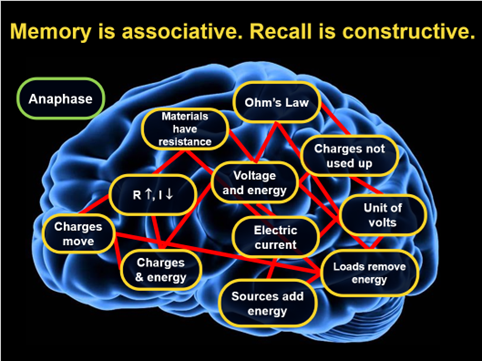
The biology of learning The learning sequence: evidence → ideas → names → understand/explain is a powerful approach. Why? It has to do with the way our brains work, with the biology of learning. Insights from cognitive scientists and psychologists, who study how we think and learn, have revealed that understanding and memory are largely associative. (This is nicely summarized in the physics article: [1409.6272] Language of physics, language of math: Disciplinary culture and dynamic epistemology. Don’t be intimidated by the terminology of the title — this is an excellent and insightful article!) What this means is that we store memories by linking them into existing networks of memory fragments. A memory does not exist by itself in an isolated form, like a file stored on a computer, instead the memory is a web of connections linking to pre-existing elements. Learning is much harder if there are few strong, useful networks to link the new memory into:
If anaphase is introduced to a person with little preparation, they struggle to connect it into their existing networks. The memory of anaphase will be very unstable and will be either quickly forgotten or incorrectly recalled. This is why rattling off a list of new terms is, biologically speaking, an unhelpful way to introduce new learning. People can remember memories that have weak associative networks, but this requires considerable effort and energy. Why not design our lessons to take advantage of how our brains work, rather than work against them? What approach should a responsible science teacher take?
Stay tuned for the next instalment of this article to find out!